Netanyahu’s Alleged Plot to Divide the Muslim World Through a New Regional Alliance

International Desk
Published: 24 February 2026, 09:04 am
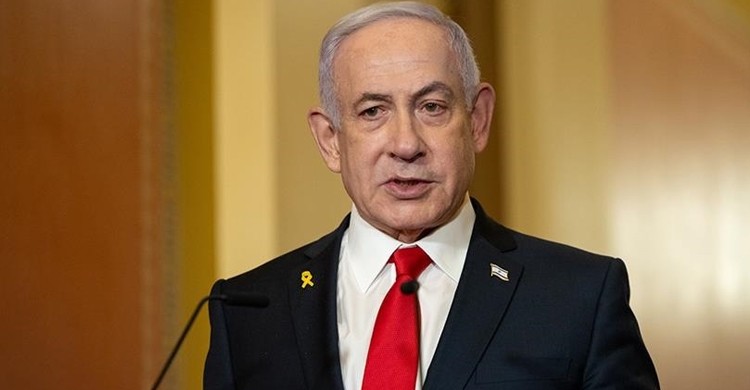
Israeli Prime Minister Benjamin Netanyahu has proposed a new regional alliance-described as a “Hexagon” (six-sided) bloc-in an apparent attempt to preserve Israel’s influence in the Middle East and counter its growing international isolation.
Speaking at a press conference on Sunday, Netanyahu outlined what he presented as an ambitious strategic framework aimed at reshaping regional power dynamics by positioning so-called “moderate” states against what he termed extremist Sunni and Shia axes. According to him, the alliance would bring together Israel, India, Greece, and Cyprus to form a common defense and strategic perimeter capable of confronting forces hostile to Israeli and Western interests.
However, the announcement has been met with widespread skepticism among international analysts and diplomats, as no country has so far formally agreed to join the proposed bloc. Questions have particularly arisen regarding Greece and Cyprus, both members of the International Criminal Court, given the legal complications stemming from allegations of war crimes in Gaza.
It is worth noting that the ICC has already issued an arrest warrant against Netanyahu over alleged war crimes related to the Gaza conflict—an issue that could place potential partner states in serious legal and diplomatic dilemmas. Andreas Krieg, a security analyst at King's College London, has dismissed the proposal as a mere “branding exercise,” arguing that it is not a genuine military alliance but rather a political attempt to repackage fragmented bilateral ties as a grand strategic vision.
Netanyahu is reportedly leveraging his claimed military successes against the Iran-backed “Axis of Resistance” to promote the initiative. By highlighting actions against groups such as Hezbollah, the Houthis, and Iraqi armed factions, he appears to be seeking to drive a wedge within Sunni-majority states. Yet analysts argue that the reality on the ground tells a different story.
Experts note that Sunni-majority countries in the Middle East are not uniting along ideological lines but are instead drawing closer diplomatically in protest against Israel’s regional aggression and what many describe as genocide in Gaza. Countries such as Turkey, Saudi Arabia, and Egypt-despite past differences-are now exploring coordinated positions against Israel’s actions.
Although Israel-India relations have deepened in recent years, doubts remain over whether New Delhi would formally join such a bloc. Indian Prime Minister Narendra Modi is reportedly preparing for a visit to Israel and has emphasized cooperation in technology and defense. Nevertheless, India has historically avoided alignment with fixed military blocs. Given its substantial economic and strategic interests across the Arab world and Iran, analysts believe India is unlikely to be drawn into Netanyahu’s “axis versus axis” confrontation.
Similarly, while Israel maintains energy and security cooperation agreements with Greece and Cyprus in the Eastern Mediterranean, these arrangements fall short of a full-fledged alliance. Despite Greece purchasing large volumes of Israeli defense equipment, Athens has recently renewed diplomatic dialogue with Turkey in an effort to ease longstanding tensions.
Political analyst Ori Goldberg argues that Israel’s global standing has deteriorated to such an extent that few states are willing to engage in long-term political alliances with it. According to him, Israel has increasingly come to symbolize regional instability, with its economy and social fabric under severe strain due to prolonged warfare.
The timing of Netanyahu’s “Hexagon” proposal is also significant, as he faces mounting pressure both domestically and internationally. Inside Israel, mass protests over judicial reforms, disputes over the conscription of ultra-Orthodox Jews, and ongoing corruption trials have severely weakened his political position. With elections looming, analysts say Netanyahu is attempting to project himself as an indispensable global leader and master strategist.
Israel’s economy is also grappling with a deep crisis, marked by business closures and downgraded forecasts from international credit rating agencies. Since 2024, sustained military operations and cross-border attacks have driven defense spending to record highs, placing an immense burden on ordinary citizens. Critics argue that the promotion of a largely hypothetical alliance is intended to divert public attention from these internal crises.
Most observers believe Netanyahu’s proposed bloc is unlikely to bring any meaningful change to the region’s complex geopolitical landscape. Instead, his sectarian and divisive rhetoric risks further polarization, undermining prospects for peace. Lacking moral credibility and legal legitimacy on the international stage, the Israeli government appears unable to secure the regional backing necessary to turn the “Hexagon” concept into reality. As such, the plan is widely expected to remain little more than a paper proposal.
Source: Al Jazeera
International



Read More

Mithu Murad Receives BMS Best Personality Award 2026 in Journalism
Civil–Military Harmony Essential for Strong State Building: Defence Adviser at DC Conference

Seven Arrested, Including Mastermind, Over Extortion Attempt at CKD Hospital